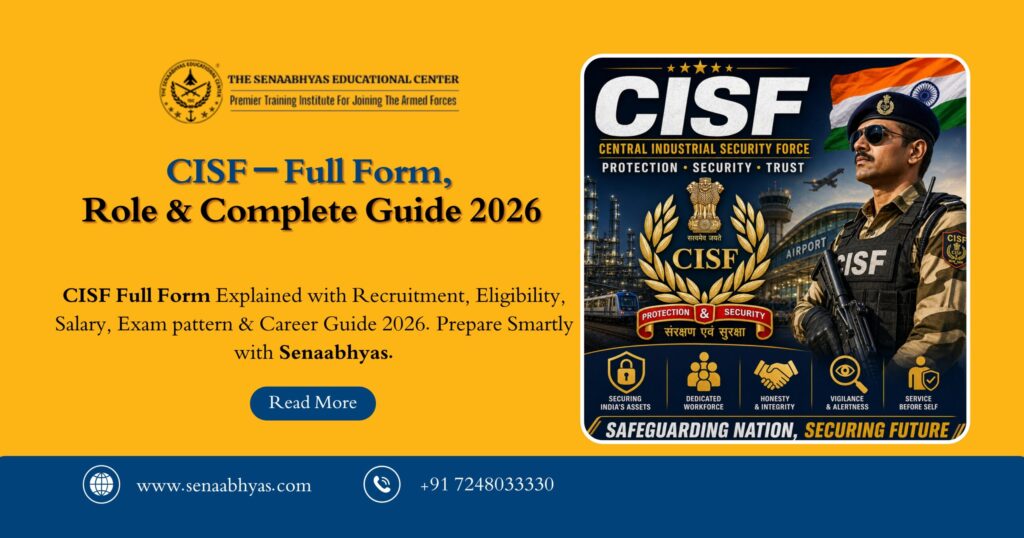
Each year, numerous aspirants in search of the CISF Full Form research opportunities in India’s paramilitary forces. However, knowing the full form of the organization is just the start of the process. Prior to applying, the candidate must be familiar with the duties of the force, the eligibility criteria, recruitment process, career growth, and skill set required for a successful career.
Those who wish to give service to the nation and earn a prestigious position in the government should consider the CISF. With adequate preparation and right guidance from organizations such as Senaabhyas, one can strategize and prepare well for future recruitment exams.
What is the CISF Full Form?
The CISF Full Form is Central Industrial Security Force. It is one of India’s Central Armed Police Forces (CAPFs) functioning under the Ministry of Home Affairs (MHA).
Established in 1969, the force was initially created to safeguard public sector undertakings. Today, its responsibilities extend far beyond industrial security. CISF personnel protect airports, metro networks, government buildings, power plants, space establishments, seaports, heritage monuments, and other critical infrastructure across the country.
For aspirants preparing for government defence careers, understanding the role of CISF is essential before applying for recruitment.
Why Choose a Career in CISF?
A career in the Central Industrial Security Force offers much more than job security. It provides an opportunity to serve the nation while building a stable and respected professional career.
Some of the major advantages include:
- Stable central government employment
- Attractive salary and allowances
- Career growth opportunities
- Medical facilities
- Pension and retirement benefits (as per applicable rules)
- Housing and welfare schemes
- Opportunity to work at prestigious national institutions
Unlike many private-sector jobs, CISF offers long-term career stability along with opportunities for promotions through departmental examinations and seniority.
Roles and Responsibilities of CISF
The responsibilities of CISF have expanded significantly over the years. Today, the force protects several strategic establishments that are critical to India’s economy and national security.
Some of the major responsibilities include:
Industrial Security
The primary responsibility of CISF is protecting government-owned industrial units and strategic infrastructure.
Personnel are deployed at:
- Power plants
- Steel plants
- Oil refineries
- Fertilizer plants
- Mining projects
Their role includes access control, surveillance, emergency response, and overall security management.
Airport Security
One of the most recognized responsibilities of CISF is managing security at airports across India.
CISF personnel perform duties such as:
- Passenger screening
- Baggage security checks
- Terminal surveillance
- Access control
- Anti-sabotage operations
Their professional approach ensures the safety of millions of passengers every year.
Metro Rail Security
Several metro rail networks in India are protected by CISF.
Responsibilities include:
- Passenger safety
- Crowd management
- CCTV monitoring
- Emergency response
- Security checks
This role requires alertness, discipline, and quick decision-making.
Government Building Protection
Many important government offices and institutions rely on CISF for security.
Personnel safeguard:
- Ministry buildings
- Government offices
- Parliament-related establishments
- Strategic installations
Their presence helps maintain a secure environment for government operations.
Disaster Response and Emergency Support
Apart from regular security duties, CISF personnel are also trained to respond during emergencies.
They assist in situations such as:
- Fire incidents
- Industrial accidents
- Natural disasters
- Security threats
Their specialized training enables them to handle challenging situations efficiently.
Eligibility Criteria for CISF Recruitment
Before applying, every aspirant should carefully understand the eligibility requirements.
Although the criteria vary depending on the recruitment notification and post, some common requirements include:
Educational Qualification
For many Constable-level recruitments:
- Candidates must have passed Class 10 or Class 12, depending on the post.
For Assistant Sub Inspector (ASI), Head Constable, and officer-level positions, educational qualifications differ according to official recruitment rules.
Candidates should always verify the latest notification before applying.
Age Limit
The minimum and maximum age vary depending on the recruitment.
Generally, candidates should check:
- Minimum age
- Maximum age
- Category-wise age relaxation
- Government reservation rules
Reading the official recruitment advertisement is always recommended.
Physical Standards
Physical fitness is one of the most important selection criteria.
Candidates are evaluated through:
- Height standards
- Chest measurement (for male candidates where applicable)
- Medical examination
- Physical Efficiency Test (PET)
- Physical Standard Test (PST)
Maintaining good fitness throughout preparation increases confidence during the recruitment process.
CISF Selection Process
The recruitment process may differ slightly depending on the post, but it generally includes multiple stages.
The selection process commonly consists of:
Written Examination
The written test usually evaluates:
- General Awareness
- General Intelligence
- Numerical Ability
- English or Hindi
- Reasoning Ability
Consistent practice and regular mock tests help improve speed and accuracy.
Physical Efficiency Test (PET)
Candidates who qualify for the written examination are called for the Physical Efficiency Test.
The test measures:
- Physical endurance
- Running ability
- Overall fitness
Preparing physically alongside academic studies is equally important.
Physical Standard Test (PST)
Officials verify whether candidates meet the required physical standards prescribed in the recruitment notification.
Measurements generally include:
- Height
- Chest (where applicable)
- Weight
- Other prescribed standards
Medical Examination
Selected candidates undergo a detailed medical examination.
The purpose is to ensure they are medically fit for service in the Central Industrial Security Force.
Salary and Career Growth
One reason many candidates choose CISF is the attractive career progression offered through central government service.
Depending on the post, employees receive:
- Basic Pay
- Dearness Allowance (DA)
- House Rent Allowance (HRA)
- Transport Allowance
- Medical Benefits
- Leave Benefits
- Pension and retirement benefits (as applicable)
In addition to financial benefits, CISF personnel also have opportunities for promotions through departmental examinations, experience, and performance.
Skills Required to Build a Career in CISF
Success in CISF recruitment requires more than academic preparation.
Candidates should develop:
- Discipline
- Physical fitness
- Mental toughness
- Leadership skills
- Communication skills
- Time management
- Decision-making ability
- Positive attitude
These qualities not only help during recruitment but also contribute to long-term professional success.
Why the Right Preparation Strategy Matters
Competition for defence and paramilitary recruitment has increased significantly in recent years. A structured preparation strategy helps aspirants stay focused and improve their performance.
Instead of studying from multiple random sources, candidates should follow:
- A planned study schedule
- Updated syllabus
- Regular mock tests
- Previous year question papers
- Daily current affairs
- Physical fitness routine
Following a disciplined preparation plan can improve both confidence and overall performance during the recruitment process.
Smart Preparation Strategy for CISF Recruitment 2026
Preparing for a CISF recruitment exam requires consistency, discipline, and the right guidance. Instead of studying everything at once, divide your preparation into manageable sections and follow a realistic timetable. This helps you cover the syllabus without feeling overwhelmed.
Begin with the core subjects, including General Awareness, Reasoning, Numerical Ability, and English or Hindi. Once your basics are clear, solve previous years’ question papers and attempt mock tests regularly. This improves both speed and accuracy while helping you understand the exam pattern.
Physical fitness is equally important. Along with academic preparation, dedicate time every day to running, endurance exercises, and basic strength training. A balanced preparation strategy increases your chances of clearing both the written examination and the physical tests.
Common Mistakes Candidates Should Avoid
Many aspirants work hard but still miss the final selection because of avoidable mistakes. Identifying these early can help you prepare more effectively.
Some common mistakes include:
- Ignoring the official syllabus and exam pattern
- Skipping regular mock tests
- Not practicing previous years’ papers
- Neglecting physical fitness preparation
- Depending on too many study resources
- Poor time management
- Avoiding revision until the last moment
A focused study plan with regular self-assessment is far more effective than studying from multiple books without direction.
Why Choose Senaabhyas for CISF Preparation?
The right coaching institute can make your preparation more organized and result-oriented. Senaabhyas has become a trusted choice among defence aspirants by focusing on concept-based learning, disciplined preparation, and continuous student support.
Instead of only covering the syllabus, the institute helps students build confidence through structured classroom sessions, regular mock tests, and doubt-solving classes. The faculty understands the latest recruitment trends and guides aspirants according to the current examination pattern.
What Makes Senaabhyas Different?
- Experienced defence educators
- Updated study material
- Regular practice tests
- Physical fitness guidance
- Individual doubt-clearing sessions
- Performance tracking and mentorship
- Student-focused learning environment
- Preparation support for NDA, AFCAT, and CDS exams
- Guidance for SSB interview preparation
Whether you are preparing for CISF, NDA, CDS, AFCAT, or other defence examinations, Senaabhyas provides a structured roadmap that helps candidates stay focused throughout their preparation journey.
CISF vs Other CAPFs
Many students compare CISF with other Central Armed Police Forces before deciding which recruitment to target. Although all CAPFs contribute to national security, their responsibilities differ.
| Force | Primary Responsibility |
| CISF | Security of airports, industries, metro networks, government establishments |
| CRPF | Internal security and counter-insurgency operations |
| BSF | Border security along India’s international borders |
| ITBP | Security along the India-China border |
| SSB | Guarding the India-Nepal and India-Bhutan borders |
Understanding these differences helps aspirants choose a career path that matches their interests and long-term goals.
Career Growth in CISF
A career in the Central Industrial Security Force offers several opportunities for professional development. With experience, departmental examinations, and consistent performance, personnel can move to higher ranks and take on greater responsibilities.
Apart from promotions, CISF personnel receive opportunities to serve at prestigious airports, government institutions, industrial units, and other strategic locations across India. This exposure helps develop leadership skills, discipline, and operational experience throughout their careers.
For candidates seeking a respected government career with stability and growth, CISF remains one of the preferred choices among the Central Armed Police Forces.
Conclusion
Knowing the full form of CISF is the very first thing that one needs to know in order to build a successful career in the Central Industrial Security Force. But one also needs to have knowledge of the procedure for recruitment in CISF, eligibility, physical requirements, and strategy of preparation.
If you are serious about making a career in the defence sector, then it can be said that good preparation with proper guidance can help you to a great extent. Senaabhyas offers coaching which helps candidates in preparing for CISF and other defence recruitment exams.
Frequently Asked Questions (FAQs)
Q.1 What is the CISF Full Form?
The CISF Full Form is Central Industrial Security Force, a Central Armed Police Force responsible for protecting critical infrastructure, airports, metro networks, and government establishments.
Q.2 What is the educational qualification for CISF recruitment?
The educational qualification depends on the post. Many constable-level recruitments require candidates to have passed Class 10 or Class 12, while higher posts have different eligibility criteria.
Q.3 Is physical fitness important for CISF selection?
Yes. Candidates must qualify the Physical Efficiency Test (PET), Physical Standard Test (PST), and medical examination as part of the recruitment process.
Q.4 Can I prepare for CISF along with other defence exams?
Yes. Since many defence examinations share common subjects like reasoning, mathematics, English, and general awareness, candidates often prepare for multiple recruitment exams together.
Q.5 Why choose Senaabhyas for CISF preparation?
Senaabhyas offers structured defence coaching with experienced faculty, updated study material, regular mock tests, physical fitness guidance, and personalized mentorship to help aspirants prepare effectively.