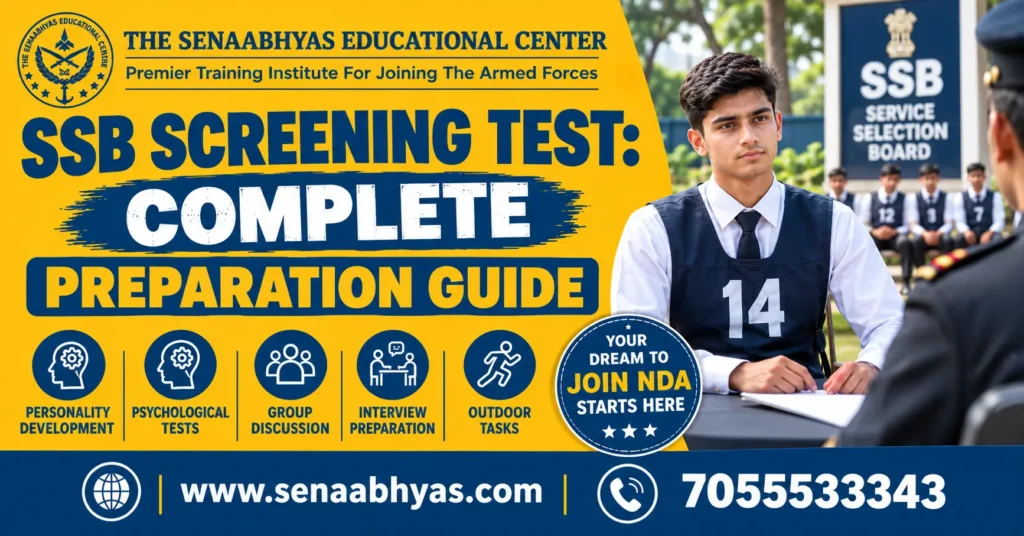
Describe a practical response.Clearing the first day of the Services Selection Board process is an important milestone for defence aspirants. The first stage is designed to assess basic intelligence, observation, reasoning, expression and group interaction before candidates move to the subsequent assessment stages.the SSB screening test primarily involves the Officer Intelligence Rating (OIR) Test and Picture Perception and Discussion Test (PPDT).
The official Indian Air Force describes Stage I as OIR and PPDT, with candidates shortlisted for the next stage based on their combined performance.
For many aspirants, the biggest challenge is not understanding the tests. It is performing under strict time limits while remaining calm and communicating effectively.
This guide explains the process, preparation strategy, common mistakes and a practical routine you can follow before reporting for SSB.
What Is the SSB Screening Test?
The SSB screening test is the first major assessment conducted during the SSB selection process. It acts as the initial screening stage.
The two important components are:
- Officer Intelligence Rating (OIR) Test
- Picture Perception and Discussion Test (PPDT)
The OIR evaluates verbal and non-verbal reasoning abilities. PPDT combines picture perception, story writing, narration and group discussion.
According to the Indian Air Force’s published SSB procedure, candidates who clear Stage I proceed to the subsequent assessment stage.
Therefore, preparation should not focus on only one component.
You need a balanced approach that develops speed, accuracy, observation, communication and group behaviour.
Understanding the OIR Test
The OIR is an intelligence assessment that generally contains verbal and non-verbal reasoning questions.
The exact test format can vary according to the entry and testing arrangements, so candidates should avoid relying on one fixed question count or timing assumption from coaching material.
Instead, prepare around the skills that repeatedly matter.
Important OIR areas
Your preparation can include:
- Analogy
- Classification
- Series
- Coding-decoding
- Direction sense
- Blood relations
- Mathematical reasoning
- Word-based reasoning
- Figure-based reasoning
- Pattern recognition
- Basic spatial reasoning
- Odd-one-out questions
The objective is not merely to solve difficult questions.
It is to solve familiar questions quickly and accurately.
How to improve OIR performance
Start with basic concepts.
Once your fundamentals are clear, introduce timed practice.
For example:
- Begin with untimed questions.
- Identify your weak topics.
- Practise each topic separately.
- Introduce short timed sets.
- Review every incorrect answer.
- Gradually increase question volume.
- Take mixed mock tests.
A useful rule is simple: accuracy first, speed second.
If you repeatedly make mistakes because you rush, increasing your speed will not solve the underlying problem.
Understanding PPDT
PPDT is another major component of the SSB screening test.
Candidates are shown a picture and asked to perceive the situation, develop a story and subsequently participate in a group discussion.
The test requires quick observation and clear expression.
It is not simply a creative-writing exercise.
Your response should be connected to the visible situation and presented logically.
What should you observe?
When the picture appears, quickly notice:
- Number of characters
- Approximate age and gender
- Facial expressions or body language
- Surroundings
- Possible action taking place
- Central character
- Possible problem or situation
- Logical sequence of events
Do not spend the entire perception time trying to create an extraordinary story.
Instead, identify the central situation and build a practical narrative around it.
How to Write a PPDT Story
A good PPDT story should be simple, realistic and structured.
One practical framework is:
Situation → Problem → Action → Result
For example, if the picture suggests a person near a damaged vehicle, avoid immediately creating an unrealistic adventure.
Think logically.
Who is the person?
Explain the possible situation or cause.
What action can the character reasonably take?
Explain what may happen after that action.
This approach helps you maintain consistency.
Your story does not need complicated vocabulary.
It needs clarity and relevance.
Your existing PPDT practice material can be used for picture-based preparation, but this article deliberately focuses on how PPDT fits into the broader screening strategy rather than repeating a complete PPDT tutorial.
The Group Discussion: Where Many Candidates Struggle
After individual preparation, the discussion component tests your ability to communicate within a group.
This is where preparation becomes different from ordinary written examination preparation.
You may have a good story, but you still need to communicate it effectively.
During the SSB screening test, avoid two extremes:
- Remaining completely silent
- Trying to dominate everyone
A healthy discussion requires participation.
Practical discussion habits
Try to:
- Speak clearly.
- Listen to others.
- Maintain a calm tone.
- Present your main idea briefly.
- Avoid unnecessary repetition.
- Respect different opinions.
- Support useful points made by others.
- Add value instead of speaking merely for visibility.
Leadership is not the same as speaking the most.
Similarly, being polite does not mean remaining passive.
The goal is balanced participation.
What Qualities Should You Develop?
The SSB screening test is only one part of a wider assessment system. The complete SSB process uses psychological testing, GTO activities, interview and conference assessment to evaluate candidates holistically.
That means your preparation should develop habits that remain useful beyond Day 1.
Focus on:
- Communication
- Reasoning ability
- Self-confidence
- Awareness
- Teamwork
- Decision-making
- Responsibility
- Observation
- Emotional balance
- Leadership behaviour
Do not try to artificially “act like an officer”.
Instead, work on becoming more organised, responsible and communicative in everyday situations.
That produces more natural responses during different assessments.
A Practical Daily Preparation Plan
A structured routine can make your preparation much more productive.
Here is a simple daily framework.
Morning: Intelligence Practice
Spend around 45–60 minutes on OIR-related questions.
Divide the session into:
- Verbal reasoning
- Non-verbal reasoning
- Timed questions
- Error analysis
Keep a notebook for recurring mistakes.
Afternoon: Current Affairs and Awareness
Spend 30–45 minutes reading reliable news.
Focus on:
- National developments
- International affairs
- Defence news
- Science and technology
- Sports
- Economy
- Important government initiatives
- Major national events
Do not attempt to memorise every headline.
Understand important issues well enough to discuss them logically.
Evening: PPDT Practice
Take one or two practice pictures.
Set yourself a time limit.
Then practise:
- Observation
- Story formation
- Story writing
- Narration
- Group discussion
If possible, record your narration.
Listen to it afterwards.
Notice whether your speech is too fast, unclear or repetitive.
Night: Self-Review
Spend 15–20 minutes reviewing the day.
Ask yourself:
- What did I improve today?
- Which OIR topic caused problems?
- Was my PPDT story logical?
- Did I communicate clearly?
- Did I listen during discussion?
- What should I practise tomorrow?
This small habit creates measurable improvement.
Common Mistakes to Avoid
Many candidates prepare extensively but lose efficiency because their preparation is based on myths.
Avoid these mistakes during your SSB screening test preparation.
1. Memorising “perfect” PPDT stories
A memorised story may not suit the picture.
Practise observation and logical thinking instead.
2. Speaking aggressively in GD
Interrupting others repeatedly does not automatically demonstrate leadership.
Contribute meaningful points.
3. Ignoring OIR
Some candidates focus heavily on PPDT and neglect intelligence practice.
That creates an unnecessary weakness.
4. Using complicated English
Good communication is about clarity.
Simple and grammatically understandable English is more useful than complicated vocabulary used incorrectly.
5. Copying someone else’s personality
There is no need to manufacture a personality for SSB.
Work on genuine self-improvement.
6. Practising without feedback
Solving hundreds of questions without identifying mistakes can create the illusion of preparation.
Feedback is what converts practice into improvement.
How to Prepare in the Final 7 Days
If your reporting date is close, do not suddenly start studying for 10 hours every day.
Instead, revise strategically.
Day 1–2
Focus on:
- OIR basics
- Verbal reasoning
- Non-verbal reasoning
- PPDT observation
- Story writing
Day 3–4
Increase timed practice.
Include:
- OIR mock tests
- PPDT stories
- Narration
- Group discussions
Day 5
Conduct a complete screening simulation.
Follow realistic time limits.
Avoid unnecessary distractions.
Day 6
Review mistakes.
Do not overload yourself with new material.
Focus on weak areas.
Day 7
Keep the routine light.
Prepare your documents and essentials.
Sleep properly.
A fresh mind is more useful than last-minute cramming.
How Senaabhyas Can Support Your Preparation
Preparation becomes more effective when candidates receive structured practice and feedback rather than depending entirely on random online material.
Senaabhyas Educational Center in Agra provides SSB-focused training covering areas such as OIR, PPDT, psychological tests, GTO activities, interviews and personality development. Its published training schedule includes OIR practice, PPDT sessions, current affairs, group discussions, GTO activities and mock interviews.
The centre’s SSB programme is led under the mentorship of Brigadier Manoj Kumar (Retd.), and the institute states that its approach includes practical exercises, individual feedback and structured preparation.
For an aspirant who needs classroom-based preparation, the value is not simply having study material.
It is the opportunity to practise repeatedly.
You can work on:
- OIR speed
- PPDT story formation
- Narration
- Group discussion
- Communication
- Current affairs
- Psychological tests
- GTO activities
- Interview preparation
- Personality development
Senaabhyas also provides dedicated SSB preparation in Agra, making structured offline practice an option for candidates who prefer direct mentoring and simulated exercises.
Before joining any coaching programme, however, candidates should understand the training methodology, course duration, faculty experience, practice structure and feedback system.
Final Preparation Checklist
Before appearing for the SSB screening test, make sure you can confidently say:
- I understand the OIR format.
- I practise verbal reasoning regularly.
- I practise non-verbal reasoning regularly.
- I can observe a picture quickly.
- I can write a logical PPDT story.
- I can narrate my story clearly.
- I can participate in a group discussion.
- I listen before responding.
- I follow current affairs.
- I have taken timed mock tests.
- I review my mistakes.
- I am working on communication and confidence.
- I have avoided memorising artificial answers.
- I understand that SSB is a holistic assessment.
The most important point is consistency.
One day of intense practice will not transform your performance.
Regular practice, honest self-assessment and feedback are much more sustainable.
Conclusion
The SSB screening test is the gateway to the remaining stages of the SSB assessment. It combines intelligence testing through OIR with picture perception, story writing, narration and group discussion through PPDT. The official selection process confirms that Stage I is based on OIR and PPDT, with candidates who clear it moving forward to subsequent assessments.
Therefore, preparation should be balanced.
Do not prepare only for reasoning questions.
Do not prepare only for PPDT stories.
And do not focus solely on speaking more during group discussions.
Instead, build a combination of speed, observation, reasoning, communication, awareness and teamwork.
With regular practice and constructive feedback, you can become more comfortable with the demands of the screening stage.
For aspirants looking for structured SSB preparation in Agra, Senaabhyas offers training that covers screening practice alongside the wider SSB assessment process.
The objective should not be to memorise an artificial “SSB personality”.
It should be to prepare yourself to think clearly, communicate naturally and respond responsibly when the actual assessment begins.
Frequently Asked Questions
Q.1 What is the SSB screening test?
The SSB screening test is the first stage of the SSB selection process. It includes the Officer Intelligence Rating (OIR) Test and Picture Perception and Discussion Test (PPDT). Candidates who clear Stage I proceed to the subsequent assessment stages.
Q.2 What should I study for the SSB screening test?
For the SSB screening test, focus on verbal and non-verbal reasoning, observation, PPDT story writing, narration, group discussion and communication. Regular timed practice is particularly useful because the assessment requires candidates to work within limited time.
Q.3 How can I improve my OIR performance?
Practise reasoning questions regularly and identify your weak areas. Start with accuracy, then introduce timed practice. Reviewing incorrect answers is equally important because it helps identify recurring patterns in your mistakes.
Q.4 How can I prepare for PPDT and group discussion?
Practise observing pictures quickly and developing realistic stories using a clear situation, problem, action and result structure. For group discussion, focus on clear communication, active listening, relevant contributions and respectful participation.
Q.5 Does coaching help with SSB screening preparation?
Structured coaching can provide regular practice, simulated exercises and individual feedback. Senaabhyas provides SSB preparation covering OIR, PPDT, psychological assessments, GTO tasks, interviews and personality development.