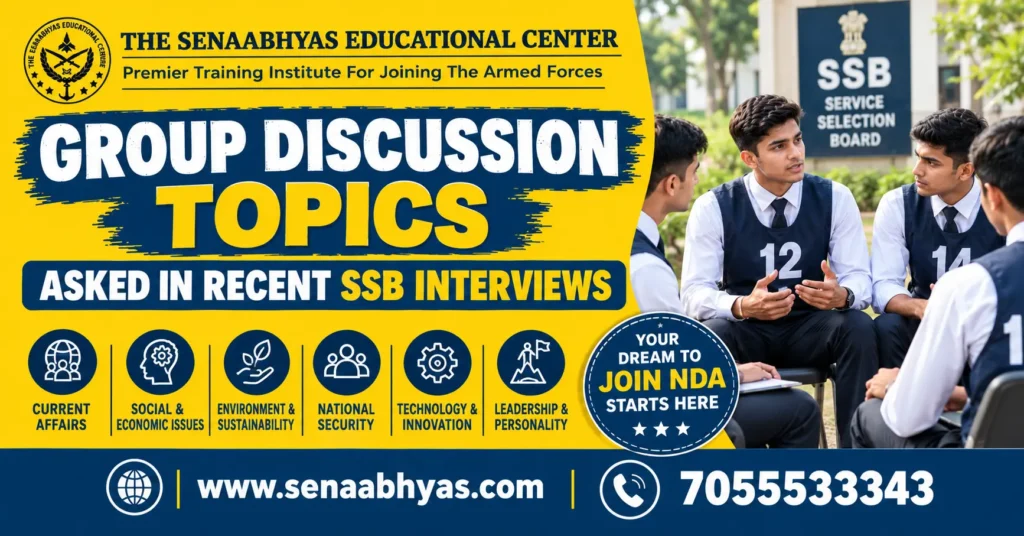
Preparing for the Services Selection Board (SSB) interview requires more than memorising current affairs. You also need to understand how to express your thoughts, listen to others and contribute meaningfully during group activities.
Among the areas candidates prepare for, SSB GD topics receive considerable attention because Group Discussion gives aspirants an opportunity to demonstrate communication, awareness, reasoning and teamwork in a group setting.
Recent candidate-preparation reports indicate that discussion themes continue to cover current affairs, defence and national security, technology, international relations, social issues and India’s development. However, candidates should remember that no public official list guarantees which topic will appear at a particular SSB board.
Therefore, the right approach is not to memorise 50 answers.
Instead, prepare the themes behind the SSB GD topics.
What Makes SSB Group Discussion Different?
The Group Discussion is part of the broader assessment environment in which candidates participate in group and individual activities. Official SSB-related information describes Stage II as involving the interview, Group Testing Officer tasks, psychology tests and conference. The assessment is holistic rather than based on one isolated activity.
That makes the discussion more than a simple speaking competition.
In a typical GD, you may be given a contemporary issue and asked to discuss it with other candidates. Your objective should be to communicate a logical viewpoint while allowing the group discussion to develop naturally.
Good preparation for SSB GD topics should therefore combine:
- Current affairs awareness
- Clear communication
- Logical thinking
- Listening ability
- Team spirit
- Balanced opinions
- Confidence
- Practical examples
- Awareness of national and international issues
The key is balance.
Speaking continuously does not automatically make a candidate effective. Similarly, remaining completely silent does not demonstrate teamwork.
Recently Reported SSB GD Topics to Prepare
Recent defence-preparation sources have reported topics connected with internal security, defence modernisation, artificial intelligence, cybersecurity, international conflicts, social development and other contemporary issues.
Based on these recent reports and recurring SSB discussion themes, candidates can prepare the following areas.
1. Artificial Intelligence and Defence
Artificial Intelligence has become an important discussion area because of its applications in surveillance, intelligence analysis, autonomous systems and decision-making.
Possible SSB GD topics include:
- Artificial Intelligence in defence
- AI and future warfare
- Advantages and risks of AI
- AI in national security
- Human intelligence versus artificial intelligence
While preparing, do not simply define AI.
Think about its benefits, limitations, ethical concerns and possible applications in India’s security environment.
2. Cybersecurity and National Security
Digital infrastructure is now closely connected with economic activity, government services and national security.
Therefore, cybersecurity is a useful area for SSB preparation.
Possible discussion questions include:
- Is cyber warfare the next major security challenge?
- Cybersecurity and India’s national security
- Social media and information warfare
- Protection of critical infrastructure
- Cybercrime and digital awareness
A strong response can connect technology with practical consequences.
For example, a cyberattack can affect financial systems, communication networks or critical infrastructure. This makes cybersecurity more than an IT issue.
3. India’s Defence Modernisation
Defence preparedness remains an important area for aspirants.
Prepare SSB GD topics related to:
- Defence modernisation
- Indigenous defence production
- Atmanirbhar Bharat in defence
- Defence technology
- Role of DRDO
- Modernisation of the Armed Forces
- Defence manufacturing in India
- Future battlefield technology
Instead of simply praising or criticising a policy, analyse it.
Ask yourself:
What is the main objective?
Which benefits can it offer?
What challenges might arise during implementation?
How can the implementation process be improved?
This three-part approach can help you speak naturally during a GD.
4. Women in the Armed Forces
The role and opportunities of women in India’s Armed Forces can lead to discussion about leadership, operational requirements, equal opportunity and changing military roles.
Possible SSB GD topics include:
- Women in the Armed Forces
- Women in combat roles
- Gender equality in defence services
- Leadership opportunities for women
- Changing roles of women in the military
Prepare facts, but also understand the different dimensions of the issue.
A mature discussion should focus on roles, training, standards, operational requirements and institutional development rather than emotional arguments.
5. India’s Internal Security
Internal security is another broad theme that can produce multiple GD questions.
Candidates should understand subjects such as:
- Terrorism
- Cyber threats
- Border management
- Left-wing extremism
- Organised crime
- Communal harmony
- Information warfare
- Illegal trafficking
One reported recent preparation source, for example, presented internal security as a GD theme and used terrorism, global warming and weapons of mass destruction as alternative leads. This demonstrates why candidates should prepare concepts rather than memorised speeches.
6. India and International Relations
International relations frequently create discussion material because global events can influence India’s economy, diplomacy and security.
Prepare themes such as:
- India-China relations
- India-Pakistan relations
- Russia-Ukraine conflict
- India’s relations with major powers
- India’s role in global affairs
- Strategic partnerships
- Energy security
- Changing global alliances
When preparing international-relations SSB GD topics, follow a simple rule:
Know what happened, why it matters to India and what the possible consequences are.
You do not need to become a foreign-policy expert.
You need enough understanding to discuss an issue logically.
7. Climate Change and National Security
Climate change is no longer limited to environmental discussions.
It can affect agriculture, water resources, migration, disaster management and economic stability.
Possible topics include:
- Climate change and national security
- Water scarcity in India
- Environmental degradation
- Disaster management
- Renewable energy
- Sustainable development
This category is useful because it allows candidates to connect environmental issues with economic and security concerns.
8. Social Media: Boon or Threat?
Social media is an easy topic to understand, but that does not mean it is easy to discuss well.
Possible questions include:
- Is social media a boon or a curse?
- Social media and national security
- Fake news and misinformation
- Social media and youth
- Digital privacy
- Social media’s impact on society
A balanced response could discuss communication and awareness benefits while also recognising misinformation, privacy and addiction-related concerns.
9. India’s Youth and Employment
Social and economic subjects can also appear among SSB GD topics.
Prepare:
- Youth unemployment
- Skill development
- Entrepreneurship
- Startup culture
- Vocational education
- Employment opportunities
- Education and employability
Try connecting the topic with solutions.
For instance, when discussing youth employment, you can consider education, industry requirements, vocational training, entrepreneurship and regional opportunities.
That creates a more complete argument than simply saying unemployment is a major problem.
10. Technology and the Future of Warfare
Technology is changing how modern militaries operate.
Candidates should understand broad concepts such as:
- Drones
- Artificial intelligence
- Cyber warfare
- Space technology
- Electronic warfare
- Unmanned systems
- Surveillance technology
You do not need highly technical knowledge.
Instead, understand how technology can influence intelligence, communication, logistics, surveillance and battlefield decision-making.
How to Prepare SSB GD Topics Without Memorising Speeches
One of the biggest mistakes candidates make is preparing fixed speeches.
Suppose you memorise a two-minute answer about artificial intelligence. Then the GTO asks a slightly different question.
You may struggle.
Instead, use a simple framework.
The 5-point preparation method
For every important topic, prepare:
- Definition – What exactly is the issue?
- Background – Why is it relevant now?
- Advantages – What positive aspects exist?
- Challenges – What problems or risks exist?
- Way forward – What practical steps can help?
This method works across most SSB GD topics.
For example, if the topic is cybersecurity, you can discuss its meaning, recent relevance, benefits of digital infrastructure, security risks and possible solutions.
That gives you a flexible structure instead of a memorised script.
What Should You Do During the Actual GD?
Knowledge is only one part of performance.
During the discussion, focus on how you interact with the group.
Try to:
- Enter the discussion confidently.
- Make your point clearly.
- Use relevant examples.
- Listen when another candidate speaks.
- Build on useful points made by others.
- Disagree respectfully.
- Keep your voice audible.
- Avoid unnecessary repetition.
- Encourage the discussion to move forward.
- Stay calm if the group becomes noisy.
Most importantly, do not treat the GD as a battle.
The objective is not to defeat the other candidates.
It is to participate constructively.
Common Mistakes Candidates Make
Even well-informed candidates can make avoidable mistakes.
Watch out for these habits:
- Speaking without listening
- Interrupting repeatedly
- Shouting to gain attention
- Repeating the same argument
- Using extreme statements without evidence
- Going completely silent
- Memorising coaching notes word-for-word
- Turning every topic into a political argument
- Using complicated vocabulary unnecessarily
- Losing confidence after another candidate disagrees
A simple sentence supported by a relevant example is often more useful than a complicated statement that lacks clarity.
How Senaabhyas Can Help With SSB GD Preparation
Preparing alone can help build general awareness, but regular practice is important if you want to improve your communication and group-discussion skills.
Senaabhyas Educational Centre in Agra provides structured SSB preparation covering areas such as psychological testing, GTO activities, personal interviews, communication and personality development.
Its SSB training approach includes practice and feedback so candidates can understand how they participate in different stages of the selection process.
The academy’s SSB course information highlights preparation for:
- Psychological tests
- Group Discussions
- Group Tasks
- Personal Interview
- OIR preparation
- Physical fitness
- Communication skills
- Personality development
Senaabhyas also provides GTO-focused training infrastructure in Agra, including facilities for group obstacle and physical training activities.
For an aspirant, this type of structured practice can be useful because knowing SSB GD topics is only the beginning.
You also need to learn how to discuss them naturally.
A Simple 7-Day Preparation Plan
If your SSB is approaching, you can organise your preparation into a weekly cycle.
Day 1 – Defence
Study:
- Indian Armed Forces
- Defence modernisation
- Defence production
- Military technology
Day 2 – National Security
Cover:
- Terrorism
- Cybersecurity
- Border security
- Internal security
Day 3 – International Affairs
Read about:
- India’s foreign relations
- Major global conflicts
- Strategic partnerships
- Energy security
Day 4 – Technology
Focus on:
- AI
- Cyber warfare
- Drones
- Space technology
Day 5 – Social Issues
Prepare:
- Youth
- Education
- Employment
- Social media
- Women empowerment
Day 6 – Environment and Economy
Study:
- Climate change
- Renewable energy
- Economic growth
- Manufacturing
- Skill development
Day 7 – Practice
Select five SSB GD topics and conduct a mock discussion.
Record yourself if possible.
Then review:
- Did you speak clearly?
- Did you interrupt?
- Did you provide examples?
- Did you listen?
- Did you repeat points?
- Did you remain calm?
This self-review can be more valuable than simply reading another list of topics.
Final Preparation Checklist
Before reporting for your SSB, make sure you can discuss broad themes rather than only specific questions.
Your preparation should cover:
- Defence and national security
- Indian and international current affairs
- Science and technology
- Social issues
- Economy
- Environment
- International relations
- India’s development
- Youth and education
- Digital technology
Also remember that current affairs change quickly.
Therefore, do not stop your preparation with this article.
Read a reliable newspaper or current-affairs source regularly and make short notes.
For every issue, ask:
What happened? Why does it matter? How does it affect India? What are the challenges? What could be the way forward?
That is a much stronger preparation strategy than memorising ready-made answers.
Conclusion
Preparing for SSB GD topics is not about predicting the exact question that will appear in your group discussion.
It is about developing the ability to understand an issue, form a balanced viewpoint and communicate it confidently.
Recent preparation reports show recurring interest in areas such as defence modernisation, cybersecurity, artificial intelligence, international relations, internal security, social development and technology. However, candidates should treat such lists as preparation guides rather than guaranteed questions.
The best strategy is therefore simple: stay updated, understand issues, practise regularly and participate naturally.
During the discussion, listen to your group, contribute meaningful points and remain respectful even when opinions differ.
With consistent current-affairs reading and realistic mock practice, you can approach SSB GD topics with much greater confidence.
For aspirants looking for structured preparation in Agra, Senaabhyas offers SSB-focused training covering GTO activities, psychological testing, interviews, communication and personality development.
Remember: the goal is not to sound rehearsed.
The goal is to think clearly, communicate effectively and demonstrate the qualities expected from an officer aspirant.
Frequently Asked Questions
Q.1 What are the most common SSB GD topics?
Common themes include defence and national security, artificial intelligence, cybersecurity, international relations, social issues, technology, India’s development, environment and current affairs. However, there is no publicly guaranteed list of questions that will be asked at every SSB board.
Q.2 How should I prepare for SSB GD topics?
Follow current affairs regularly and prepare each topic through five points: definition, background, advantages, challenges and way forward. Then practise discussing the subject without memorising a fixed speech.
Q.3 Does SSB GD require strong English?
You should focus on clear and understandable communication rather than complicated English. A candidate who expresses logical thoughts confidently and listens to others can communicate more effectively than someone who uses difficult vocabulary without clarity.
Q.4 What qualities are important during an SSB Group Discussion?
Focus on communication, logical reasoning, awareness, listening, teamwork, confidence, adaptability and respectful interaction. The broader SSB assessment is holistic, with assessors considering performance across different testing components.
Q.5 Can Senaabhyas help with SSB Group Discussion preparation?
Yes. Senaabhyas Educational Centre in Agra provides structured SSB preparation that includes Group Discussions, GTO activities, psychological tests, personal interviews, communication and personality development. Regular mock practice and feedback can help candidates become more comfortable with group-based assessment.