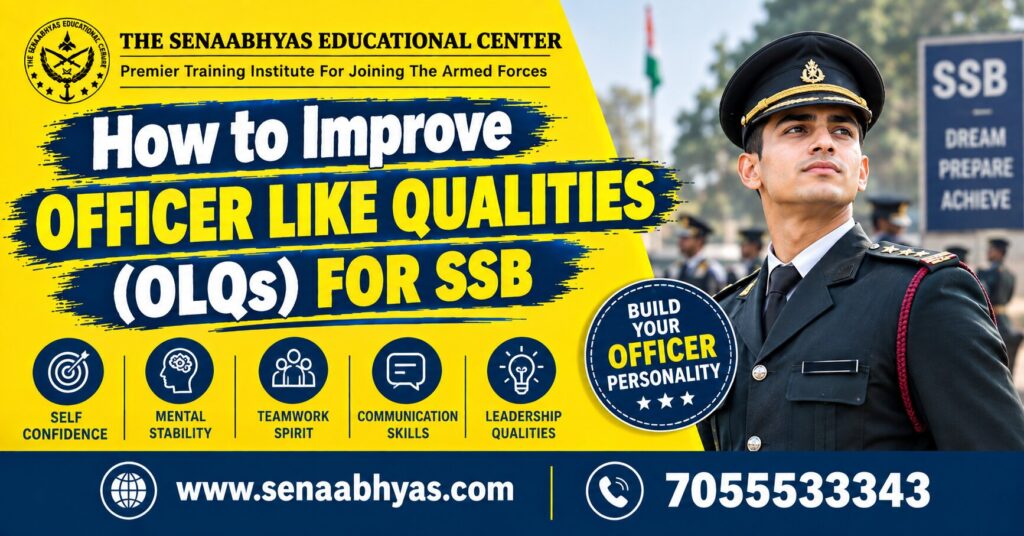
Recommendation at SSB interviews is not about learning the answers by heart or trying to be an officer for five days. It is about developing the skills which enable you to think critically, act responsibly, work in a team, express your thoughts confidently, and take initiatives when needed.
SSB interview process is structured in such a way that the interviewing officer, psychologist and Group Testing Officer would be able to conduct a holistic assessment of the candidate. In the notice released by UPSC about the examination, it is mentioned clearly that these tests are conducted to evaluate the presence and absence of Officer Like Qualities.
That is the reason why all the serious aspirants start developing these skills even before attending SSB. Senaabhyas adopts a practical approach to SSB training, with individual counselling, psychological assessment preparation, GTO training, mock interviews, and profile-based coaching. The faculty of Senaabhyas consists of retired military personnel and assessors.
What Are Officer Like Qualities in SSB?
Officer Like Qualities are the behavioural and personality traits expected from a potential military leader. They are not separate skills that you can simply learn from a book. Instead, they are reflected through your everyday decisions, communication, teamwork, reactions, and approach to challenges.
For an aspirant, this means SSB preparation should go beyond practising PPDT stories or memorising interview questions. Your preparation needs to show how you naturally respond when faced with responsibility, disagreement, pressure, limited resources, or an unfamiliar situation.
The SSB process uses different techniques to assess the candidate from multiple perspectives. Stage I includes the Officer Intelligence Rating test and Picture Perception and Description Test, while Stage II includes the interview, GTO tasks, psychology tests, and conference.
So, if you want to improve your performance, the better question is not “How can I impress the assessor?” but “How can I become a better version of myself?”
The OLQ Areas You Need to Develop
A practical SSB preparation plan should work on different dimensions of personality instead of concentrating only on speaking skills.
Effective Intelligence and Practical Thinking
A potential officer needs to understand situations and find workable solutions. You do not always get perfect information in real life, so your ability to analyse a problem and make a sensible decision matters.
You can develop this quality by taking everyday situations seriously. Instead of immediately asking someone else what to do, first think about the available options, possible consequences, and the most practical solution.
During SSB preparation, practise analysing situations without becoming unnecessarily complicated. Read newspapers, discuss real-world issues, solve reasoning problems, and participate in group activities where you need to reach decisions.
Reasoning Ability
Logical thinking helps you understand people, situations, and problems more effectively. It also supports your performance in the OIR and other assessment activities.
You can improve reasoning by regularly working on:
- Verbal and non-verbal reasoning
- Logical puzzles
- Situation-based questions
- Data interpretation
- Analytical discussions
However, do not turn reasoning practice into a purely exam-oriented exercise. Try to understand why a particular solution works. That habit gradually improves your decision-making ability.
Organising Ability
An officer has to manage people, time, resources, and responsibilities. Strong organisation does not mean making complicated schedules. It means knowing what needs to be done, deciding priorities, and completing tasks responsibly.
Start with your own routine. Plan your study hours, physical training, revision, sleep, and daily responsibilities. If you repeatedly postpone simple tasks, it becomes difficult to demonstrate genuine responsibility in more demanding situations.
At Senaabhyas, structured preparation and regular assessment can help candidates identify areas where they need greater consistency and discipline. The institute also maintains smaller batch sizes to facilitate personal attention.
Build Confidence Without Becoming Artificial
Confidence is important, but there is a major difference between confidence and overconfidence.
You do not need to speak loudly, dominate every group discussion, or pretend to know everything. Genuine confidence means expressing your thoughts clearly, accepting mistakes, listening to others, and remaining composed when someone disagrees with you.
A useful way to develop confidence is to deliberately put yourself into situations where communication is required.
Try:
- Speaking in small group discussions
- Giving short presentations
- Participating in debates
- Explaining a topic without reading notes
- Talking to people outside your usual friend circle
The objective is not to become the loudest person in the room. It is to become someone who can communicate ideas clearly and respectfully.
Improve Communication for the SSB Interview
Communication skills can significantly influence how effectively you express your personality during the interview.
You do not need sophisticated English to perform well. Clear thinking and honest expression are more important than using difficult vocabulary.
If you struggle while speaking, begin with simple daily exercises. Pick a current topic and speak about it for two minutes. Record yourself. Listen again and identify unnecessary pauses, repetition, unclear sentences, or gaps in your reasoning.
Gradually increase the duration.
You can also practise explaining your:
- Educational background
- Family environment
- Hobbies
- Strengths and weaknesses
- Academic performance
- Career goals
- Responsibilities
- Achievements and failures
This preparation is useful because the interview should feel like a conversation about your actual life, not a rehearsed performance.
Turn Teamwork Into a Daily Habit
Team spirit is one of the most important areas to develop for GTO activities. Candidates sometimes make the mistake of thinking that leadership means controlling the group.
It does not.
A strong team member knows when to lead, when to support someone else, and when to listen. If another candidate has a better idea, accepting it is not weakness. It can actually demonstrate maturity.
Start developing teamwork outside the coaching environment. Participate in sports, group projects, volunteering, college activities, competitions, or community events.
During group discussions and GTO practice, focus on contributing rather than competing.
That small change in mindset can make your behaviour much more natural.
Develop Initiative Through Real Responsibilities
Initiative means being willing to act instead of waiting for someone else to solve every problem.
You can build this quality through ordinary responsibilities. Organise a college event. Help your team complete a project. Take responsibility for a family task. Volunteer for something that requires planning.
The activity itself does not matter as much as your approach.
Ask yourself:
Did I identify the requirement? Did I take responsibility? Did I involve others? Did I complete the task?
These habits are more valuable than trying to manufacture examples for an SSB interview.
Strengthen Emotional Stability Under Pressure
SSB candidates often focus heavily on intelligence and communication while ignoring emotional control.
Military life involves uncertainty, pressure, setbacks, and responsibility. A candidate who becomes extremely frustrated after every mistake may struggle to respond effectively in challenging situations.
Emotional stability does not mean suppressing emotions. It means controlling your response.
You can practise this by:
- Staying calm after making mistakes
- Listening before reacting
- Avoiding unnecessary arguments
- Accepting constructive criticism
- Maintaining your routine during stressful periods
Physical exercise can also support discipline and stress management. A consistent fitness routine gives you another opportunity to practise perseverance.
Improve Social Adaptability
An officer works with people from different backgrounds, personalities, and experiences. You cannot expect everyone to think exactly like you.
Social adaptability means adjusting your approach without losing your values.
Spend time interacting with different people. Listen to their opinions. Participate in group activities. Learn to disagree respectfully.
If you naturally avoid social situations, do not try to transform yourself overnight. Start with small interactions and gradually increase your participation.
This approach is more sustainable than adopting an artificial personality immediately before your SSB.
Develop Sense of Responsibility
Responsibility is best demonstrated through action.
If you make a commitment, complete it. If you make a mistake, accept it. If a task belongs to you, do not constantly wait for reminders.
Start keeping simple commitments in your daily routine.
For example, if you decide to study for three hours, complete those three hours. If you promise to help your team, follow through. If you miss a target, analyse why and make a correction.
These small behaviours gradually build a stronger sense of accountability.
Practise GTO Tasks With the Right Mindset
GTO activities are not simply physical games. They provide opportunities for assessors to observe how candidates behave in group situations.
The official UPSC description confirms that Stage II includes Group Testing Officer tasks, alongside psychological tests and the interview.
During preparation, focus on:
- Clear communication
- Cooperation
- Practical planning
- Initiative
- Listening
- Physical involvement
- Encouraging team members
- Respecting group decisions
Do not enter every task with the mindset that you must become the leader. Sometimes the most effective contribution is helping another candidate perform better.
Make Psychology Preparation About Yourself
Psychological tests should not become an exercise in writing what you think an assessor wants to read.
Instead, understand your own personality.
For example, if you describe yourself as disciplined, ask yourself where discipline is visible in your life. If you claim that you are responsible, think about actual situations where you accepted responsibility.
This self-awareness helps create consistency across different stages of assessment.
Your responses should naturally reflect your experiences, values, and thought process.
Prepare Your Personal Interview From Your Real Profile
One of the strongest ways to improve SSB performance is to know yourself thoroughly.
Before your interview, prepare around your actual profile rather than memorising generic answers.
Review:
- Academic record
- Family background
- School and college activities
- Sports
- Hobbies
- Friends
- Responsibilities
- Achievements
- Failures
- Career motivation
- Current affairs
- Defence awareness
If your interviewer asks a follow-up question, genuine understanding will help you respond naturally.
This is also why profile mapping can be valuable. Senaabhyas specifically highlights individual guidance, profile mapping, and PIQ analysis as part of its SSB preparation approach.
A Practical 30-Day OLQ Improvement Plan
If your SSB date is approaching, you do not need a complicated routine. You need consistency.
Week 1: Self-Assessment
Identify your strengths and weaknesses. Ask teachers, friends, or family members for honest feedback.
Write down three qualities you want to improve.
Week 2: Communication and Confidence
Start daily speaking practice. Participate in discussions and practise explaining your opinions clearly.
Avoid memorising speeches.
Week 3: Teamwork and Leadership
Take part in group activities. Practise listening, contributing ideas, and accepting responsibility.
Focus on making the team better rather than trying to look better.
Week 4: SSB Simulation
Combine interview practice, psychological exercises, group tasks, and self-analysis.
After every practice session, ask:
What did I do well? What did I avoid? What should I change next time?
This feedback loop is far more useful than simply repeating the same practice.
How Senaabhyas Can Support Your SSB Preparation
Choosing the right SSB coaching programme can provide structure when you are unsure where to begin. Senaabhyas offers SSB-focused preparation covering screening tests, psychological assessments, GTO tasks, personal interviews, and individual profile mapping.
The institute’s mentoring approach is supported by defence experience, including Brigadier Manoj Kumar (Retd.), who has 33 years of Armed Forces service and is described by Senaabhyas as an expert in SSB, counselling, and motivation. The wider faculty includes retired assessors such as Psychologists, GTOs, and Interviewing Officers.
For candidates who want more personalised preparation, the institute also emphasises smaller batches and individual attention rather than relying only on mass classroom instruction.
If you are serious about improving your SSB performance, you can explore Senaabhyas‘s SSB preparation options and speak with its academic counsellors about the programme that fits your current level.
Common Mistakes That Can Hurt Your OLQ Development
Trying to act like an officer is one of the biggest mistakes candidates make.
Other common problems include:
- Memorising interview answers
- Copying someone else’s personality
- Speaking unnecessarily in group tasks
- Confusing aggression with leadership
- Giving fake hobbies
- Ignoring physical fitness
- Avoiding self-analysis
- Practising only before the SSB
- Trying to impress assessors
Remember, the objective is not to create a five-day personality. It is to develop qualities that remain visible across different situations.
Conclusion
Officer Like Qualities Improvement Program is all about not transforming yourself into something that you are not. Rather, it aims at developing certain traits like good habits, sound mind, better communication skills, responsible behavior, teamwork, emotional stability, and confidence to deal with unknown situations.
If your objective is to excel in SSB interviews, then make sure that you develop these qualities way before your reporting date. And by following a self-improvement program along with realistic practice at an institution of defence, you can do so successfully.
Frequently Asked Questions
Q.1 What are Officer Like Qualities in SSB?
Officer Like Qualities are behavioural and personality traits assessed during SSB to understand a candidate’s suitability and trainability for officer-level responsibilities. The assessment considers performance across interview, psychology, GTO activities, and conference rather than relying on one test.
Q.2 Can Officer Like Qualities be developed?
Yes. Many qualities can be strengthened through consistent practice, responsibility, teamwork, communication, self-awareness, physical activity, and exposure to real-life situations. The aim should be genuine personality development rather than memorised behaviour.
Q.3 How can I improve OLQs before my SSB interview?
Start by identifying your weaknesses. Then work on communication, teamwork, decision-making, initiative, responsibility, emotional control, and physical fitness through daily activities and structured SSB practice.
Q.4 Does SSB coaching guarantee recommendation?
No coaching institute can guarantee an SSB recommendation. Coaching can provide structured practice, professional feedback, and exposure to the assessment process, but the final performance depends on the candidate.
Q.5 Why choose Senaabhyas for SSB preparation?
Senaabhyas provides structured SSB preparation covering screening, psychology, GTO, interview practice, profile mapping, and individual guidance. Its team includes experienced defence personnel and retired assessors.