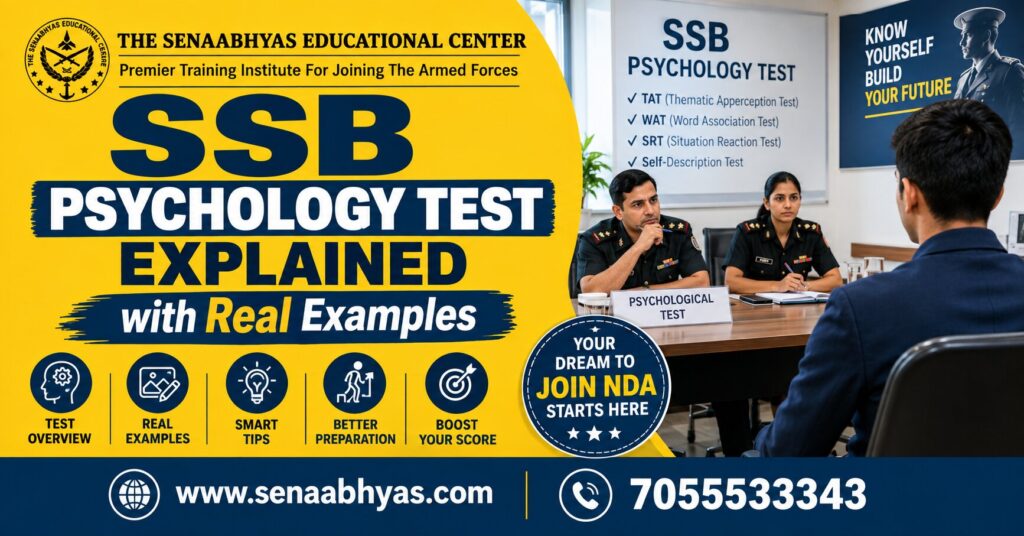
Passing the SSB interview entails more than just having knowledge about defence or answering questions in a very coherent way. The psychological test is one where the evaluator observes how you react to certain situations, perceive people, make judgments, and communicate your thoughts. For those serious candidates, special preparation for the SSB Psychology Test would help you to not just attempt but face the challenges confidently.
At Senaabhyas, the SSB preparation course revolves around practical experience, mentoring, and wider knowledge about the process of selection as an officer. The SSB preparation at Senaabhyas encompasses psychological test, GTO tasks, personal interview preparation, PIQ analysis, and mentoring based on the profile. The mentors at Senaabhyas have been retired defence personnel and assessors.
What Does the SSB Psychology Test Actually Assess?
The psychological assessment is designed to understand an aspirant’s Officer Like Qualities (OLQs) through responses to different situations and stimuli. Instead of asking you to directly say, “I am confident” or “I am a good leader,” the assessment gives you opportunities to demonstrate qualities through your responses.
This is why memorising model answers is usually a poor strategy. Your responses should reflect your genuine personality, practical judgement, emotional balance, responsibility, and ability to respond constructively.
For an aspirant looking for SSB psychology coaching, the better approach is to understand the purpose behind each assessment and practise expressing your natural thinking clearly.
The major psychological assessments generally associated with SSB preparation are:
- Thematic Apperception Test (TAT)
- Word Association Test (WAT)
- Situation Reaction Test (SRT)
- Self Description Test (SDT)
Each requires a different response style. Preparing for all four together gives you a more consistent approach.
TAT Preparation: Turn Your Thinking Into a Practical Story
The Thematic Apperception Test presents pictures or situations and asks candidates to develop stories around them. The purpose of preparation is not to create dramatic stories or portray yourself as a superhero.
A strong response should demonstrate realistic thinking, initiative, responsibility, and constructive action.
Realistic Example
Suppose a picture shows a young person standing near a damaged bridge while several people are nearby.
A weak approach could turn the situation into an unrealistic rescue story where the protagonist solves every problem alone.
A practical approach could be:
A college student notices that a village bridge has been damaged after heavy rain. He informs the local authorities, coordinates with nearby residents to keep people away from the unsafe section, and helps arrange an alternate route while repair work is initiated.
Notice the difference.
The second story does not try to prove that the candidate is extraordinary. It demonstrates observation, initiative, responsibility, teamwork, and practical problem-solving.
That is the mindset aspirants should develop through TAT practice for SSB.
WAT Practice: Respond Naturally, Not Artificially
The Word Association Test presents words one after another, requiring candidates to create short responses within limited time.
This is where many aspirants make a common mistake: they try to convert every word into a motivational quotation.
That can make responses sound rehearsed.
Consider the word “Failure.”
Instead of writing something generic such as:
“Failure is the stepping stone to success.”
A more natural response could be:
“Failure identifies gaps that need improvement.”
The second response communicates a practical attitude without sounding memorised.
Another Example
Word: Responsibility
Possible natural response:
“Responsibility encourages people to complete their duties sincerely.”
The objective is not to produce the most impressive sentence. Your focus should be on developing a balanced, constructive, and natural thought process.
For candidates seeking WAT preparation for SSB, regular timed practice is more useful than collecting hundreds of memorised sentences.
SRT Preparation: Think Fast, Think Practical
The Situation Reaction Test challenges candidates with short situations and limited time to respond.
This section requires practical judgement.
Imagine the situation:
You are travelling to an important examination when your vehicle breaks down and you are already running late. What will you do?
A practical response could be:
“Arrange alternate transport, inform the concerned person if necessary, and reach the examination centre as quickly as possible.”
The response is direct. It identifies the problem and immediately moves toward a solution.
Another Example
Suppose:
You notice a classmate being bullied by a group of students.
A constructive reaction could be:
“Intervene safely, stop the situation, support the student, and report the matter to the appropriate authority.”
The important element is action.
For SRT practice, avoid unnecessarily long explanations. Under time pressure, learn to identify the problem, decide the priority, and respond sensibly.
SDT Preparation: Know Yourself Before You Describe Yourself
The Self Description Test requires candidates to reflect on how they see themselves and how others may perceive them.
This is where genuine self-awareness becomes valuable.
Instead of presenting yourself as perfect, understand your strengths and areas that genuinely require improvement.
For example:
“My friends consider me dependable because I usually complete responsibilities assigned to me. I sometimes spend too much time checking my work, so I am working on making decisions more efficiently.”
This sounds more credible than:
“I have no weaknesses and always perform perfectly.”
Nobody is perfect. A mature candidate understands personal strengths while recognising areas for improvement.
For SSB personality development, this kind of honest self-assessment is far more valuable than preparing an artificial personality.
How to Prepare for SSB Psychology Tests Without Memorising Answers
The biggest advantage comes from improving the thinking process behind your responses.
A useful preparation routine can include:
- Timed TAT story practice
- Daily WAT exercises
- SRT situation drills
- Regular self-description writing
- Current affairs discussions
- Group discussions
- Personal reflection
- Feedback from experienced mentors
The goal is consistency.
If your TAT stories show responsibility but your SRT responses repeatedly avoid taking action, the overall picture may appear inconsistent. Similarly, if your SDT describes you as highly confident but your other responses show hesitation, that difference deserves attention during preparation.
This is why SSB interview preparation should not be treated as four isolated tests.
What Makes Senaabhyas Different for SSB Preparation?
Choosing an SSB coaching institute should involve more than checking advertisements or collecting study material. The quality of mentorship matters because psychological preparation requires observation and individual feedback.
Senaabhyas has a defence-focused training environment with specific attention to psychological assessments, GTO tasks, interviews, PIQ analysis, and individual profile mapping. Its faculty includes retired assessors, psychologists, GTOs, and interviewing officers, according to the institute’s published information.
The institute was established in 2015 and describes its approach as a modern Gurukul, combining disciplined learning with personal mentorship. Its training model also emphasises small batches and individual attention rather than treating every aspirant exactly the same way.
For an aspirant considering SSB coaching in Agra, this personalised approach can be particularly useful when the objective is to identify preparation gaps rather than simply complete a syllabus.
Build Your SSB Preparation Around Your Own Profile
One of the most important things an aspirant can do is understand that SSB preparation should not turn everyone into the same candidate.
Your academic background, interests, family environment, achievements, hobbies, responsibilities, failures, and goals all contribute to your personal profile.
For example, if you have genuinely participated in sports, you should be able to discuss:
- What sport you played
- Your position or role
- What you learned
- Challenges you faced
- How you handled losses
- What teamwork meant to you
Similarly, if your PIQ mentions a hobby, prepare to discuss it honestly.
This makes SSB interview coaching more meaningful because preparation becomes profile-oriented rather than answer-oriented.
Common Mistakes to Avoid During Psychological Preparation
Aspirants often make preparation harder than necessary.
1. Memorising Stories
A memorised TAT story may not naturally fit every picture. Learn the thinking process instead.
2. Writing Unrealistic Reactions
Not every situation requires heroic action. Practical judgement matters.
3. Trying to Sound Perfect
Aspirants sometimes avoid mentioning any weakness. Genuine self-awareness is more credible.
4. Ignoring Time Limits
Knowing what to write is not enough. You must practise responding within the available time.
5. Copying Another Candidate’s Personality
Your responses should reflect you. Artificial responses can create inconsistency across different assessments.
6. Preparing Psychology in Isolation
The psychological tests form part of a larger SSB assessment. Your interview, GTO performance, and other interactions also matter.
A Practical 7-Day Psychology Preparation Routine
If your SSB is approaching, you can use a focused practice schedule.
| Day | Main Focus | Practice |
| Day 1 | TAT | Timed picture-based stories |
| Day 2 | WAT | Timed word responses |
| Day 3 | SRT | Practical situation reactions |
| Day 4 | SDT | Self-analysis and profile review |
| Day 5 | Mixed Practice | TAT + WAT + SRT |
| Day 6 | Mock Assessment | Complete timed practice |
| Day 7 | Review | Identify patterns and improve |
Do not judge your preparation only by the number of questions completed.
Instead, review how you think.
Are your responses practical? Are they consistent? Do they show initiative? Are you unnecessarily negative? Do you tend to avoid responsibility? These questions can reveal much more than simply counting practice attempts.
Get Expert Feedback Before Your SSB
Self-practice is useful, but external feedback can reveal patterns that you may not notice yourself.
For example, you may believe your TAT stories demonstrate leadership, while a mentor may notice that your protagonist repeatedly works alone. You may think your SRT responses are decisive, while feedback reveals that you spend too much time explaining instead of acting.
This is where structured SSB psychology coaching becomes valuable.
At Senaabhyas, the SSB preparation model includes individual guidance and profile-based assessment alongside psychological tests, GTO preparation, interview training, and PIQ analysis.
If you are serious about improving your performance, the best next step is not to collect more model answers. It is to practise, receive feedback, correct your approach, and practise again.
Who Should Join SSB Psychology Coaching?
Professional guidance can be particularly useful if:
- You are appearing for SSB for the first time.
- You struggle to complete timed psychology tests.
- Your responses feel repetitive or unrealistic.
- You are unsure how to analyse your own personality.
- You need individual feedback on TAT, WAT, SRT, or SDT.
- You want integrated preparation for psychology, GTO, and interview.
- You want a structured SSB preparation environment.
If you already have strong preparation, targeted mock assessments may be enough. If you are starting from scratch, a complete SSB program can provide a more organised roadmap.
Why Senaabhyas Can Be a Practical Choice for Aspirants
Senaabhyas positions its SSB training around practical exposure rather than only classroom theory. Its published SSB approach includes screening preparation, psychological assessment, GTO activities, personal interviews, PIQ analysis, and individual profile mapping.
The institute also highlights training from retired assessors and experienced defence professionals. Brigadier Manoj Kumar (Retd.), the institute’s Chairman, is described by Senaabhyas as having 33 years of Armed Forces service and expertise in SSB, counselling, and motivation.
That experience can be valuable for aspirants who want more than generic preparation material. Instead of asking, “What is the perfect answer?“, the better question is, “How can I become better prepared to demonstrate my actual potential?”
That shift can make your preparation more genuine and useful.
Conclusion
The true purpose of SSB Psychology Test preparation is not to gain an array of impressive responses. The true purpose is to cultivate an effective, well-balanced, and responsible attitude towards situations along with increasing awareness of your own strengths and limitations.
Preparation in a systematic manner with feedback will help serious aspirants make the whole process more concentrated. Senaabhyas provides you with a combination of psychological testing along with GTO, interviews, PIQ analysis and profiling, and this is done by experienced defense personnel.
In case your intention is to succeed in SSB, you need to do real self-assessment, practice within realistic time constraints, get expert feedback, and improve. The purpose here is not to create an officer-type of personality for just five days but to prepare yourself to showcase your true capabilities with confidence and consistency.
Frequently Asked Questions
Q.1 What is the SSB Psychology Test?
The SSB Psychology Test is a set of psychological assessments used during SSB to understand a candidate’s responses, personality traits, thought process, and suitability for officer selection.
Q.2 What are the main psychology tests in SSB?
The commonly prepared assessments are TAT, WAT, SRT, and SDT. Each tests a different aspect of how candidates perceive situations and respond to them.
Q.3 Can I prepare for the psychology tests at home?
Yes. You can practise TAT stories, WAT responses, SRT situations, and self-description independently. However, expert feedback can help identify recurring patterns and improve your approach.
Q.4 Should I memorise TAT stories and WAT answers?
No. Memorising fixed answers can make your responses artificial. Focus on developing practical thinking, speed, consistency, and genuine self-awareness.
Q.5 Does Senaabhyas provide SSB psychology preparation?
Yes. Senaabhyas offers SSB preparation that includes psychological assessment along with GTO, personal interview, PIQ analysis, and individual profile guidance.
Q.6 Why is individual feedback important in SSB preparation?
Individual feedback helps identify weaknesses that may not be visible during self-practice, such as unrealistic stories, inconsistent reactions, poor time management, or gaps between your stated personality and actual responses.