Introduction
India has developed tremendously over the decades in terms of defense technologies, and one area where India’s military prowess stands tall is their missile system. The subject of Indian Missiles is thus not only relevant for defense aspirants but even for those who are interested in the concepts of national security and warfare. The Indian missile systems are indeed vital for establishing the nation’s strategic standing.
The subject of Indian Missiles is commonly found in defense examinations and interview rounds conducted by organizations. Organizations such as Senaabhyas help aspirants gain insights into the subject.
What are Missiles?
Missiles are advanced weapons designed to deliver warheads to a specific target with high accuracy. They are guided systems that can travel long distances and are capable of carrying conventional or nuclear payloads.
Missiles are generally classified based on:
- Range
- Launch platform (land, air, sea)
- Type of target
India has developed a wide range of missile systems to meet different defence requirements. These systems are designed by organizations like the Defence Research and Development Organisation (DRDO).
Types of Indian Missiles
To understand Indian Missiles better, it is important to know their main categories. Each type serves a specific purpose in defence strategy.
1. Ballistic Missiles
Ballistic missiles follow a curved trajectory and are used for long-range targets. They are one of the most powerful missile systems.
2. Cruise Missiles
Cruise missiles fly at low altitude and are known for their precision. They are used for targeted strikes.
3. Surface-to-Surface Missiles
These missiles are launched from the ground and strike targets on land.
4. Surface-to-Air Missiles
Used for air defence, these missiles target enemy aircraft and drones.
5. Air-to-Air Missiles
Launched from aircraft to destroy enemy aircraft in mid-air.
Understanding these categories is important for defence exam preparation and general awareness.
List of Major Indian Missiles and Their Range
India has developed several advanced missile systems with different ranges and capabilities. Below is a simplified list of some important missiles.
| Missile Name | Type | Range |
| Prithvi | Surface-to-Surface | 150–350 km |
| Agni-I | Ballistic | 700–900 km |
| Agni-II | Ballistic | 2,000 km |
| Agni-III | Ballistic | 3,000 km |
| Agni-IV | Ballistic | 4,000 km |
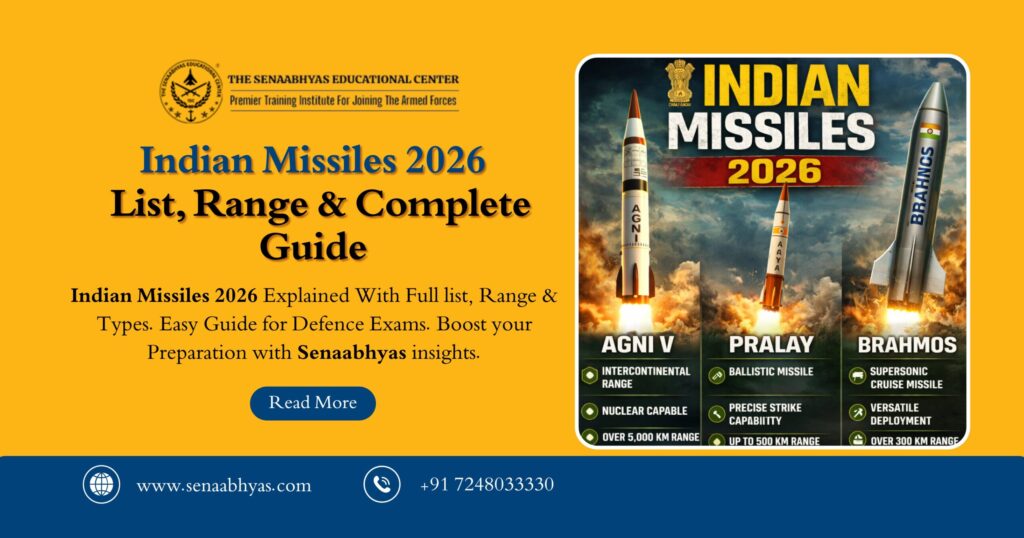
| Agni-V | Intercontinental | 5,000+ km |
| BrahMos | Cruise Missile | 290–400 km |
| Akash | Surface-to-Air | 25–30 km |
| Nag | Anti-Tank | 4–7 km |
| Astra | Air-to-Air | 110 km |
This list of Indian Missiles is important for competitive exams and defence-related studies.
Agni Missile Series
The Agni missile series is one of the most powerful parts of India’s defence system. These are long-range ballistic missiles designed for strategic deterrence.
Key Highlights:
- Agni-I to Agni-V cover short to intercontinental ranges
- Capable of carrying nuclear warheads
- Developed by DRDO
The Agni series plays a major role in strengthening India’s nuclear capabilities and maintaining strategic balance.
BrahMos Missile
The BrahMos missile is one of the fastest cruise missiles in the world. It is developed jointly by India and Russia.
Features:
- Supersonic speed
- High precision targeting
- Can be launched from land, air, and sea
BrahMos is widely recognized for its advanced technology and operational efficiency.
Akash Missile System
The Akash missile system is a surface-to-air missile used for air defence. It protects against enemy aircraft and missiles.
Key Features:
- Medium-range air defence system
- High accuracy and mobility
- Used by Indian Army and Air Force
It plays an important role in protecting critical areas from aerial threats.
Importance of Indian Missiles in Defence
The development of Indian Missiles has significantly improved the country’s defence capabilities. These systems ensure national security and act as a strong deterrent against potential threats.
Key Importance:
- Strengthens national security
- Enhances strategic defence capability
- Acts as a deterrent to enemies
- Supports modern warfare systems
A strong missile system is essential for maintaining peace and stability.
Latest Developments in Indian Missile Technology
India continues to invest in advanced missile technology to stay ahead in defence capabilities.
Recent developments include:
- Improved range and accuracy
- Advanced guidance systems
- Hypersonic missile research
- Integration with modern defence systems
These innovations make Indian Missiles more effective and reliable in modern warfare scenarios.
Role of DRDO in Missile Development
The Defence Research and Development Organisation (DRDO) plays a key role in developing missile systems in India.
Contributions:
- Research and development of missile technology
- Testing and deployment of new systems
- Continuous upgrades and innovation
DRDO has been the backbone of India’s missile development program.
Why Defence Aspirants Should Study Indian Missiles
For students preparing for defence exams, knowledge of Indian Missiles is extremely important.
Reasons:
- Frequently asked in exams like NDA, CDS, AFCAT
- Helps in SSB interview discussions
- Builds general awareness about defence
Institutes like Senaabhyas provide structured learning to help students understand these topics clearly and confidently.
How Senaabhyas Helps in Defence Preparation
Preparing for defence exams requires the right guidance and strategy. Senaabhyas supports students by providing structured learning and updated study material.
Key Benefits:
- Concept-based learning approach
- Regular mock tests and practice sessions
- Updated defence-related content
- Focus on overall personality development
- Preparation support for NDA, AFCAT, and CDS exams
- Guidance for SSB interview preparation
With proper guidance, students can build strong knowledge and perform better in exams.
Conclusion
Indian Missiles Development indicates India’s increasing capability in defence technology. Be it short-range missiles or intercontinental missiles, India has constructed an extremely robust missile infrastructure.
In terms of defence preparations, it is essential for aspirants to learn about missile systems not only because it is exam-oriented but also for knowledge about national security. Under the supervision of organizations such as Senaabhyas, aspirants will be able to prepare themselves well.
FAQs
Q.1 What are Indian Missiles?
Indian Missiles are advanced defence systems developed by India to protect the country and strengthen its military capabilities.
Q.2 Which is the most powerful missile in India?
The Agni-V is considered one of the most powerful missiles with a range of over 5,000 km.
Q.3 What is the range of BrahMos missile?
The BrahMos missile has a range of approximately 290–400 km.
Q.4 Who develops missiles in India?
Missiles in India are mainly developed by the DRDO (Defence Research and Development Organisation).
Q.5 Why are Indian Missiles important?
They play a crucial role in national security, defence strength, and strategic deterrence.
Get in Touch
The Senaabhyas Educational Center
Address: Opposite Jaipuria Sunrise Greens, Bagdha Mod, Barauli Ahir, Agra, Uttar Pradesh 283125
Location: https://maps.app.goo.gl/17kNrRAA1nD1xLYw5
Phone Number: 07055533343
Whatsapp Number: 07248033330,
Email: info.senaabhyas@gmail.com
Follow Senaabhyas On Facebook Follow Senaabhyas On Instagram